Meet Les.
Les saves more on protein, starch, and fiber drying costs.
Why meet Les.
Les deploys Bepex drying systems that use less water, less gas, and less operating expense–significantly less.
All in a smaller footprint than conventional dryers.
And all the while maintaining or improving particle size control/flexibility, cleanability, and maintainability.
Less water
Less gas
Less emissions
Less footprint
Less installation cost
Less operating expense
MORE margin
MORE sustainable
Those who meet Les.
BEFORE
Soy fiber feed at 85-90% moisture was dried in a rotary steam tube dryer producing a feed-grade product.
AFTER
Mechanical separation and drying were combined, lowering overall drying costs by 60%, while producing higher-quality food-grade product opening up new higher-margin market potential.
LESS Drying Costs
MORE MARGIN
BEFORE
Vegetable protein at 95% moisture dried in a spray dryer.
AFTER
Customer mechanically reduced the feed moisture, delivering a 75% moisture cake to our drying system. This lowered drying costs and emissions by 80% while maintaining a premium product in half the space.
LESS Drying Costs
HALF THE FOOTPRINT
BEFORE
Vegetable fiber feed at 95% moisture dried in a spray dryer.
AFTER
Mechanical separation and drying were combined, lowering drying costs and emissions by 88%, while improving particle size control.
LESS Drying Costs
MORE CONTROL
Meet Les for yourself.
We’ve created an Excel spreadsheet template you can use to calculate for yourself what savings you might expect when you meet Les. Complete the form to receive the template.
Our experts are happy to speak with you about the template, your situation, and how the Bepex drying technologies can help you save on operating expenses, while maintaining or improving upon your product quality goals.
Fill out the form to get the Drying Savings Estimator.
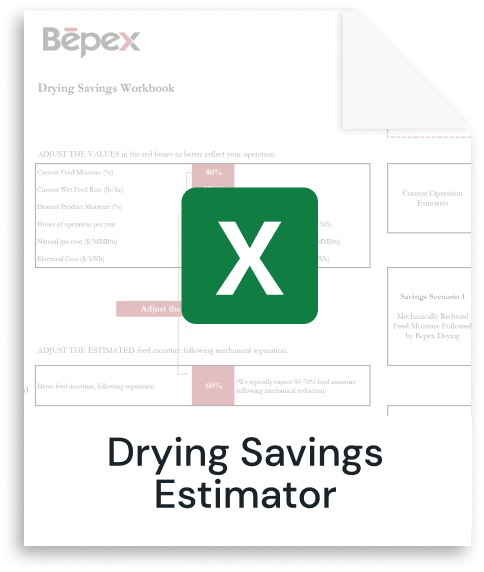
The Drying Savings Estimator plots an estimated look at your current operation against two potential drying scenarios. The first scenario incorporates mechanical reduction of your feed moisture to lower the amount of water that needs to be dried.
The second scenario also reduces the feed moisture, but introduces process gas recirculation, further lowering energy use and emissions. Each scenario is presented with the estimated natural gas consumption, CO2 emissions, and OPEX.